
Is it harder to lose fat and build muscle after 40?
Stepping over the threshold from 39 to 40 is scary.
Our algorithms suddenly shift to peri-menopause, talk of muscle and bone density loss, disease and face lifts. The cultural messaging around aging is so intensely negative that it is very, very difficult to imagine that you will have any control over your body composition, and if you do, it’s an up-hill battle.
Shifting body composition is hard, it’s always been hard but now you have a convenient reason you’re not doing the work necessary to change it and then there is a NOCEBO effect at work. Nocebo implies that people are more likely to experience an adverse effect if they expect or are worried about the adverse effect. The adverse effects may be physically experienced and are often clinically diagnosable.
When every message tells you that your body is about to become harder to manage, it can change what you expect and what you believe is worth attempting. That doesn’t mean all symptoms are imagined or that struggling is a personal failure but it does mean we need to examine the story we’re being told about being in our 40s and 50s.
Does building muscle, losing fat and recovering from training actually become meaningfully harder when we get into our 40s? How much comes from biological changes, how much from our training history, and how much from the demands of life?
Let’s look at what the research can actually tell us.
The research gives us good reason to be optimistic.
A 2026 systematic review and meta-analysis brought together 126 studies involving 4,019 women. Resistance training produced substantial improvements in strength in both perimenopausal and postmenopausal women, with no statistically significant difference between the groups’ responses. Menopause clearly doesn’t switch off your ability to get stronger. (pubmed.ncbi.nlm.nih.gov).
In a 2024 randomised controlled trial, 55 postmenopausal women, averaging 58 years old, took part in a 12-week study of resistance training and protein intake. Both training groups increased their biceps muscle thickness, measured using ultrasound. These women were building muscle well beyond their fortieth birthdays. Adding the higher-protein diet did not produce a clear additional benefit over training alone in this particular trial. (em-consulte.com, pubmed.ncbi.nlm.nih.gov).
Your body doesn’t check your birth certificate and change the rules of fat loss on your fortieth birthday. There is no established biological cliff between 40 and 50 even when we adjust for perimenopause. If losing fat has become harder, we need to ask what has actually changed.
Are you moving less? Sleeping less? Has your training become sporadic? Are meals squeezed between meetings, school runs and caring for everyone else? Less movement can reduce your energy expenditure. poor sleep can make food intake harder to manage, a packed schedule can make consistency harder to achieve. Together, they can erase the deficit you thought you were creating.
A large international study found that daily energy expenditure, adjusted for body size and composition, was broadly stable between ages 20 and 60. Your individual calorie needs can change, but the idea that your metabolism suddenly grinds to a halt in your 40s doesn’t hold up.
Sleep shows how easily we can miss the mechanism. In a randomised trial of adults with overweight adults who habitually slept too little, extending sleep reduced daily calorie intake by approximately 270 calories compared with the control group. This wasn’t a menopause study, but it demonstrates that something as ordinary as sleep can meaningfully affect how much we eat, and guess what perimenopause often impacts? If you said sleep you win.
And postmenopausal women do lose weight and body fat in structured lifestyle interventions. I have personally seen this in my own client base. Programmes combining calorie restriction, physical activity and behavioural support produce results. The practical tools remain familiar: resistance training to help preserve muscle, sufficient protein to support muscle retention and fullness, and food intake that creates a sustainable deficit. Aerobic exercise can contribute to energy expenditure and improve cardiovascular fitness but in terms of fat loss it’s an adjunct to the main course.
The work still needs doing. “I’m over 40” tells us very little about which part needs attention. Look at your food, your movement, your training and your sleep. Find the obstacle you can actually act on.
There is a gap in the research here.
We have studies showing that postmenopausal women can lose fat, and studies showing that younger resistance-trained women can lose fat. What we’re missing is a direct comparison of women in their 20s and 30s with women in their 40s and 50s who already resistance train, eat sufficient protein and follow comparable fat-loss programmes.
That research would need to measure actual changes in fat mass, account for starting body composition and training experience, and assess food intake, energy expenditure, sleep and adherence. It would also need to distinguish chronological age from menopausal stage.
Without those comparisons, we cannot confidently say whether older trained women lose fat at the same rate under equivalent conditions. Equally, we cannot claim that menopause inherently makes them less capable of doing so. Reports that fat loss feels harder should be given attention, but they don’t establish why it is harder. That is the question the research still needs to answer.
What about recovery?
“Wait until you’re 40, you won’t recover like you used to.” It’s repeated so confidently that you would assume the research had settled it. I’ve said it myself, convinced my recovery had changed, but I’m exposed to the same cultural messaging as you are. My experience alone can’t tell me whether age is responsible, and direct comparisons between younger and older adults challenge that story.
A 2025 systematic review and meta-analysis brought together 36 studies comparing exercise-induced muscle damage in younger and older adults. Older adults did not show greater losses in muscle function at 24 or 72 hours after exercise, or at the point of greatest impairment.
And here’s the finding that deserves your attention: younger adults reported more muscle soreness than older adults.
That pattern appeared across all the soreness comparisons analysed. The familiar story tells us to expect more soreness as we age; this review found the opposite.
There is also comparison data specifically in resistance-trained women. A 2021 study compared 13 postmenopausal women with 19 younger premenopausal women after a squat protocol emphasising the lowering phase. Researchers assessed soreness, jump performance and blood markers of muscle damage and inflammation over the following 48 hours. They found no significant differences between groups in the postexercise markers assessed, despite their different ages and hormonal profiles.
Less soreness doesn’t automatically mean faster recovery, and these studies don’t establish identical responses under every training condition but they directly challenge the assumption that older muscles necessarily suffer more damage or need longer to recover. If you’re struggling between sessions, examine your training load, food intake, sleep and symptoms. Adjust to the response you’re actually seeing. Your age alone is not a recovery assessment.
An older woman who lifts regularly and one who has spent years sedentary may respond very differently to the same workout. Grouping them together by age obscures what training can change.
In a 2001 study, older women initially experienced greater strength losses and more signs of muscle damage after unfamiliar exercise than younger women. After 12 weeks of resistance training, however, the older women showed no greater muscle injury or strength loss than the sedentary younger women. Training had reduced their susceptibility to that exercise.
This is why findings in untrained older adults need careful interpretation. They can reveal the combined effects of aging and inactivity without telling us how someone who trains consistently will respond. I have less body pain now than I did at 30, after two years partying in Berlin. I’m older, but I train consistently and take better care of myself. My experience cannot establish what happens to everyone, but it gives me good reason to question the assumption that younger always means feeling better.
If recovery has become harder, look beyond your birthday. Has your training been consistent? Are you returning after a long break? Have you increased the workload while cutting food and sleeping less? Those questions give you something concrete to investigate—and a way to adjust.
Taking responsibility doesn’t require turning your struggle into a verdict on your character.
We all make good and bad decisions, and we make them under different pressures. Plenty of my clients have made better financial choices than I have. My expertise in training doesn’t put me above them, any more than their financial success puts them above me.
If I sat across from a financial adviser with mountains of debt, I wouldn’t want them to tell me my choices had played no part in it—or that I was too old to improve my position. I’d want an honest assessment and a workable plan. Reassurance wouldn’t pay the debt, and shame wouldn’t pay it either.
We can take the same approach to our bodies. Acknowledge the circumstances, recognise the choices we can influence and deal with where we are now. You don’t have to feel ashamed before you act. You just need to decide what you’re going to do next.
Your dieting history hasn’t necessarily damaged your metabolism, but you may still need to recover from your most recent diet.
If you’ve spent months restricting food and now feel exhausted, preoccupied with eating or unable to train well, immediately cutting calories again may be a poor decision. A period at maintenance can give you room to eat adequately, rebuild a consistent training routine and assess whether those problems improve.
There is a physiological distinction here too. In one study, the reduction in resting energy expenditure beyond that predicted from weight loss was roughly halved after four weeks of weight stabilisation. That study involved adults with obesity, rather than trained women, but it shows why measurements taken during active restriction don’t necessarily describe someone’s longer-term condition.
There’s no universal recovery timetable. The length and severity of the diet, your current health and your response should guide the next phase. Sometimes moving forward means spending time eating enough, and training with resistance before attempting to lose more.
What does this look like outside a research paper?
Jennifer Lopez stands out even in an industry full of women with access to excellent trainers, chefs and treatments. To my eye, she has one of the most impressive physiques in show business, and her documented training deserves attention.

Jennifer Lopez leaving the gym
In 2019, as she approached 50, her trainer Dodd Romero described hour-long workouts four to five times a week. Her lower-body routine included weighted lunges, sumo squats, leg presses, leg extensions, leg curls and hip thrusts. She was also filmed leg-pressing nearly 300 pounds. Access to support helps her sustain that workload. It doesn’t perform the repetitions for her.
Jessica Biel’s shared routines include Romanian deadlifts, hip thrusts, weighted lunges, rows and ring chin-ups—including an L-sit variation that requires substantial upper-body and core strength.
In her 2025 lower-body demonstration, she performed four sets of ten hip thrusts and Romanian deadlifts using two 10 kg dumbbells, explaining that she would normally use a barbell for the hip thrusts. A later workout featured 30-pound dumbbells for a combined hip thrust and press. These are examples of loads she has shown publicly, rather than a complete training record.

Jessica Biel in The Better Sister
When people admired her muscular physique in The Better Sister, they were seeing someone with years of consistent strength training behind her. The exercises are familiar to anyone who lifts; the strength to perform them takes time to develop.
See Biel’s lower-body routine and her upper-body training with Ben Bruno.
Then there’s my client Angela. She is 50, has lost 25 pounds while adding 6 pounds of muscle, deadlifts 240 pounds and does a 450 pound hack squat! She lifts heavy three days a week and eats an average of 120 to 140 grams of protein a day.
Her results illustrate why scale weight alone can miss part of the achievement. She hasn’t simply become lighter; she has built muscle and developed substantial strength along the way.
These examples cannot tell us how every woman will respond or isolate the effects of age and hormones. They do, however, give us something concrete to picture: women beyond 40 lifting challenging weights, developing strength and building muscular physiques. Angela’s experience brings that possibility into the coaching room.
Your body may still be capable. Is there room in your life?
By our 40s and 50s, many of us are managing careers, children, aging parents and a household. Sometimes there’s a perfectly capable adult at home who still expects someone else to organise dinner, remember appointments and locate his socks.
Training has to compete with all of that. A session gets cancelled when a parent needs help, lunch becomes whatever is available between meetings, and bedtime slips because the evening is your only chance to finish the work or have ten minutes to yourself.
Over time, you’re training less, eating differently and sleeping fewer hours, perhaps without noticing how far your routine has shifted. When progress stalls, age gets the blame before anyone examines the week you’re actually living.
Taking responsibility includes looking at how your household operates. Who gets uninterrupted time, whose plans are treated as optional, and who picks up the work when something unexpected happens? If your training is always the first thing sacrificed, a calendar reminder won’t solve it. The people who share your life need to share the responsibilities.
Start with arrangements you can maintain. Protect two or three realistic training slots, keep a few easy meals with sufficient protein available, and have a shorter workout ready for busy days. Agree on who handles childcare, dinner or other tasks while you train, rather than trying to negotiate it as you’re leaving.
Some weeks will still unravel. But your health needs a regular place in the schedule, because waiting until everyone else has everything they need can mean waiting indefinitely.
Menopause: what does the research actually tell us?
A study following women through menopause, a trial suppressing ovarian hormones and an experiment in mice can all contribute to our understanding. They answer different questions, though, and shouldn’t be treated as interchangeable evidence about your ability to build muscle or lose fat.
The Study of Women’s Health Across the Nation, known as SWAN, found that fat gain accelerated and lean mass began to decline during the menopause transition. The rate of overall weight gain did not accelerate at its onset, which shows why body weight and body composition need to be considered separately.
SWAN followed a general population cohort. It wasn’t a controlled study of experienced lifters following progressive training programmes and eating sufficient protein. Its findings describe changes observed in those women; they don’t establish that the same changes are inevitable under different training and nutritional conditions.
The training research we’ve already discussed answers another question: can postmenopausal women respond to resistance exercise? Yes. The 2024 trial demonstrated increases in muscle thickness and strength. That doesn’t erase the SWAN findings, but it gives us evidence that intervention can improve the outcomes we care about.
Training also doesn’t guarantee a symptom-free transition. A survey of 868 competitive female Masters weightlifters found joint pain was associated with age, previous injury and the severity of menopausal symptoms. These were women who lifted, so explaining every ache as “just being unfit” would be inaccurate. Equally, a survey cannot establish that hormonal changes caused the pain, and protein intake wasn’t controlled.
The useful question is what has changed for the woman in front of us. Is she sleeping poorly, experiencing pain, missing sessions or struggling with a workload she previously tolerated? Those observations can guide adjustments. Menopause gives us context, but it doesn’t tell us her training capacity, nutritional needs or likely results.
What about those “two sudden bursts of aging”?
You may have seen the countless headlines announcing that we suddenly age at 44 and 60. The media just lapped that up didn’t they? They came from a 2024 study examining molecular markers in 108 adults aged 25 to 75, followed for a median of just 1.7 years.
The researchers reported clusters of molecular changes around those ages. They did not demonstrate that everyone’s strength, recovery or ability to lose fat suddenly deteriorates at those birthdays. Nor did they follow the same people from young adulthood into old age.
There is now another reason to question the headline. In July 2026, Nature Aging published an editor’s note stating that the reliability of some analyses used to identify those peaks was under review. The authors agreed to the notice.
That doesn’t establish that aging is linear or that nothing changes biologically. It means the claim that we all experience two predictable collapses goes beyond what this study can establish—and the analyses behind its most publicised finding are themselves being questioned.
But doesn’t disease risk increase with age?
Yes. Cardiovascular risk can increase through the menopause transition, giving us good reason to monitor blood pressure, cholesterol and other health indicators. That doesn’t establish a reduced ability to build muscle or lose fat.
Training can also influence age-related health outcomes. In a year-long trial of early postmenopausal women, squats and deadlifts twice a week maintained spinal bone density on average without HRT. Women who neither trained nor used HRT lost an average of 3.6%.
Increasing risk is a reason to take action and monitor your health, not evidence that your body has stopped responding to training.
Have we started living down to our expectations?
By 40, you’ve probably heard enough warnings about aging to recognise the script: expect less strength, more pain and a body that becomes increasingly difficult to change. Hear it often enough and you may start making decisions around a decline you haven’t actually tested.
Psychologist Ellen Langer explored this idea in her famous 1979 Counterclockwise experiment. Eight older men spent five days in a setting recreated to resemble 1959. They were asked to speak and behave as though they were living twenty years earlier. The music, conversations and surroundings all belonged to their younger lives.
Accounts describe improvements in posture, movement and physical function. It’s an arresting story, but a small exploratory experiment. Later experiments give us firmer ground. In Feeling Younger, Being Stronger, 49 adults aged 52 to 91 completed a grip-strength test. Those given positive feedback about their performance compared with people their age subsequently felt younger and increased their grip strength. The control group showed neither change.
They hadn’t built new muscle between tests. Something about the feedback changed the performance they could produce.
The 2025 AgingPLUS trial examined whether an intervention addressing negative aging beliefs, confidence and planning could change activity. Among 335 adults aged 45 to 75, participants improved their objectively measured daily steps and moderate-to-vigorous activity compared with a health-education control group. Several components worked together; this wasn’t a test of positive thinking in isolation.
These studies don’t prove that menopause symptoms are a nocebo. They do show why we should take aging expectations seriously. What you believe you can do can influence what you attempt, the effort you bring and the habits you build.
Give yourself a chance to find out what you can do. Follow a structured programme, record your lifts and assess your progress over time. If something becomes harder, investigate the change rather than assuming your age explains it. Let your own results help shape your expectations.
Train the woman in front of you
Two women can be 50 and need very different programmes. One may be learning to squat for the first time, another may be deadlifting 240 pounds. Their age won’t tell me which weight to put on the bar.
I start with their training experience, current strength, health, symptoms and available time. Then we build a programme they can perform consistently and progress as their capacity develops. That means recording exercises, weights and repetitions, rather than choosing a new workout every time they enter the gym.
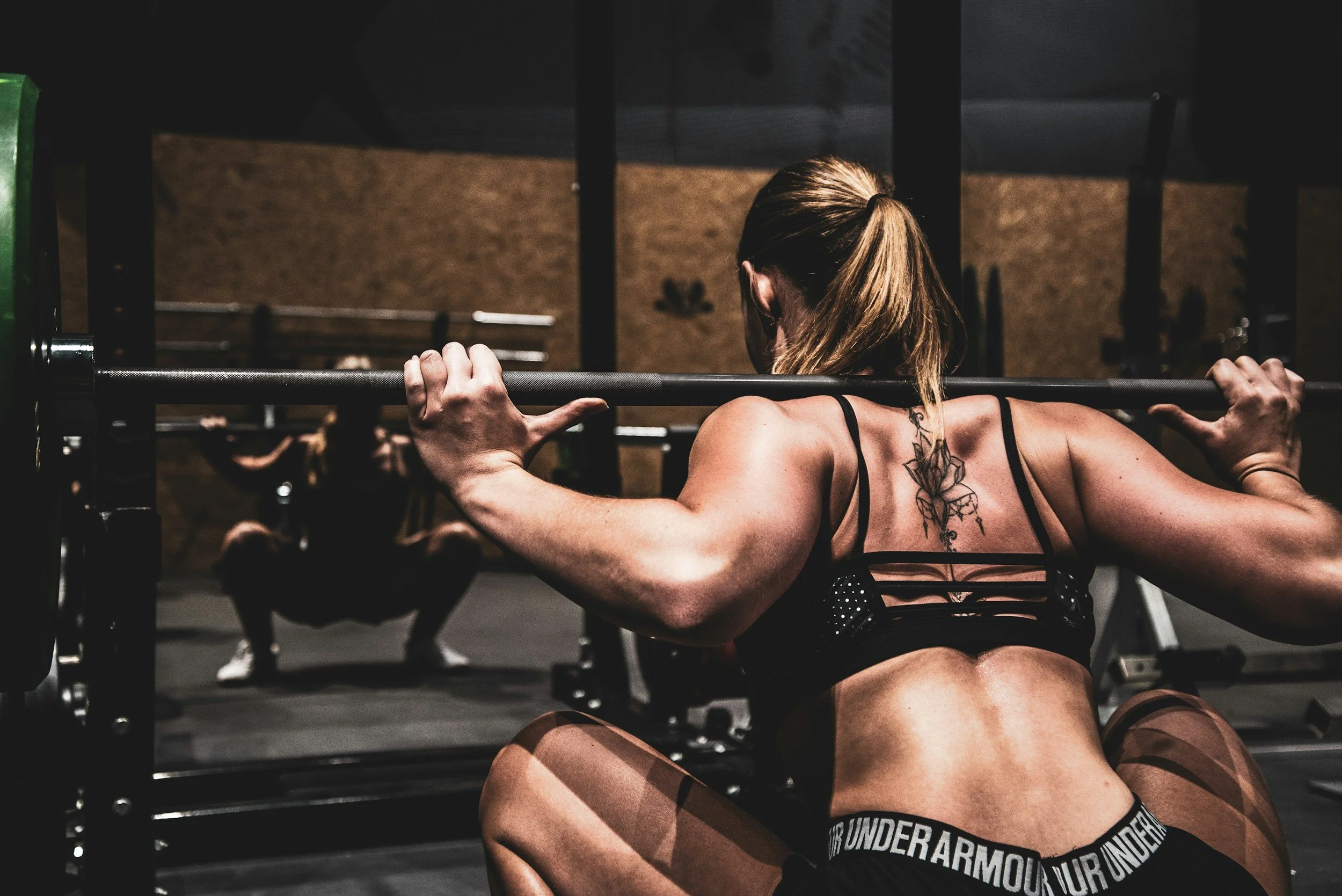
woman squatting in the gym
Nutrition needs the same attention. Sufficient protein supports the goal, but we also need enough total food to train productively. If fat loss is appropriate, the deficit should leave room for recovery and a life the client can sustain. For someone exhausted by prolonged restriction, maintenance may be the better starting point.
Losing fat while building muscle is possible, but the balance will differ. A beginner has more scope for rapid training improvements than an experienced lifter, whose muscle gains may come slowly. We assess progress over months, using weight trends, measurements, photographs and gym performance together. A stronger lift alone doesn’t prove muscle growth, just as an unchanged scale doesn’t rule out fat loss.
When progress stalls, we review the evidence. Has the programme been followed, has food intake matched the plan, and has sleep or daily activity changed? If pain or other symptoms interfere, we adjust the training and seek appropriate assessment where needed.
This is how I coach: establish a starting point, choose a workable approach, measure the response and make informed changes. If you want help building that plan, get in touch with me at The Woman’s Body Coach.
At 40 or 50, you may have symptoms to manage, habits to rebuild and a schedule that barely leaves room for you. You can acknowledge all of that and still expect progress.
Angela is 50 and hack squats 450 pounds. Your goal might be your first proper push-up, more muscle or a smaller waist. Choose it, make a plan and give yourself enough time to see what consistent work can produce.
There is no single definitive plan for women over 40. There is a starting point, yours, and a programme built around your experience, health, goals and the time you have available. It needs to progress with you, with adjustments based on how you respond. Your age cannot provide those instructions.
You’ve heard plenty about what the next decade might take from you. What would you like to build during it?